We hope you take a little time to learn more about our industry, the producers and the high-quality pork produced in British Columbia.
This industry is not a big one, producing only about 5% of the pork consumed by British Columbians, but it is significant and different from other regions. Our family farms carefully raise pigs to high standards for specialty markets in BC, whether for local butchers, independent grocers or your favourite restaurants.
As a consumer, asking for BC Pork products ensures that you are taking home to your family pork of high quality that is fresh, versatile and delicious!
BC PORK…HIGH QUALITY, SPECIALTY PORK PRODUCTS, PROUDLY GROWN CLOSE TO HOME
BC Pork Sector Overview
Snapshot
- In 2025, there were 9 commercial pork producers licensed in BC
- BC farms are concentrated in the central Fraser Valley; there is also one farm in the Peace River, one in the Kootenays, and two on Vancouver Island.
- In 2025, BC’s licensed producers raised an estimated 130,000 hogs.
- The BC hog industry farm gate revenue is valued at approximately $16 million.
- BC’s industry produces both market hogs (75% of production) and round hogs/sucklings (whole hogs for BBQ and Asian markets).
To be considered commercial, farms must produce a minimum of 300 market hogs a year for processing. There are more than a thousand additional unlicensed producers, who grow less than 300 hogs a year. Most are smaller farms with mixed livestock and maybe some crops. All hogs, regardless of whether they come from a commercial farm or a small farm are required, by law, to register their Premise ID with PigTrace — a national traceability program designed to ensure protection for the Canadian pork industry and its customers.
The BC industry produces less than five percent of the pork consumed in BC, while the remaining 95% is sourced from farms located in the rest of Canada. BC commercial producers are price takers based on North American pork prices.
The BC pork sector is represented by two organizations: the British Columbia Pork Producers Association (BCPPA) and the British Columbia Hog Marketing Commission (BCHMC). The BCPPA, incorporated in 1929 represents the sector in such areas as lobbying, animal care, food safety and traceability, environment, research and development, and consumer education. The BCPPA works closely with the Canadian Pork Council (CPC) on nationally validated programs, trade, communications, nutrition, research, and issue management. The BCPPA works with the BC Agriculture Council on provincial issues.
The BCHMC was started in 1980 and is authorized under the Natural Products Marketing (BC) Act. The Commission regulates all registered producers. It is responsible for orderly production and marketing through promoting and regulating the production, transportation, packaging, storage, and marketing of hogs. The Commission collects levies on all hogs sold by licensed members. The levies are used to fund programs and the daily operations of both the BCHMC and the BCPPA.
The BCPPA focuses its marketing and production towards local, ethnic, and specialty markets using the brand: “BC Pork—Proudly grown close to home.” Production is focused on specialty markets, such as local butchers, independent grocers, and restaurants.
The vast majority of hogs produced in BC are raised in modern confinement units engineered and designed to provide strict environmental controls. All commercial producers must participate in the national Pig Safe|Pig Care (Canadian Pork Excellence (CPE)) program that is managed by the Canadian Pork Council and administered by each province. The mandatory program has ten modules covering the following areas:
- Personnel training
- PigSafe (food safety) five modules
- PigCare (animal welfare)
- PigTrace (traceability)
- Biosecurity
- Transportation
- Other programs
- Canadian ractopamine-free pork certification program
- Outdoor access certification
- Multiple species certification
- Group sow housing certification
Commercial producers are audited annually by independent validators. PigCare is based on Canada’s Recommended Code of Practice for the Care and Handling of Farm Animals – Pigs.
There are two stages involved in hog production: farrowing (raising piglets from birth to weaning) and growing-finishing (growing weaners through to market weight). Many producers raise hogs from farrow-to-finish. In other cases, a producer will manage a farrowing operation where pigs are raised from birth to weaning on solid or liquid feed, subsequent to which another producer will grow and finish them to market weight. Typically, it takes from five to six months to raise a hog from farrow-to-finish. BC has higher costs of production because of its high land and feed costs.
During the growing-finishing stage, hogs are fed specially formulated high-energy rations. Hog rations may be prepared and supplied by local feed companies, or they may be prepared on-farm using integrated feed milling and delivery systems. Manure is collected and stored in concrete-lined pits, in concrete-lined or earthen lagoons, or composted and stored as a solid by-product until it can be applied to cropland later as a fertilizer.
Most hogs in BC are delivered to one of two meat packing plants in the Fraser Valley. Each packer has specific weight requirements for hogs delivered to them, but they generally fall into two live weight categories as either round hogs (for the barbecue market) or market hogs. Live weights for round hogs run from 40 to 45 kilograms while market hog weights typically range from 90 to 95 kilograms.
The majority of BC pork is shipped to two large processors: one is a federal plant and the other is a provincial plant. There are additional abattoirs throughout the province that process smaller numbers of hogs from mostly small scale farms.
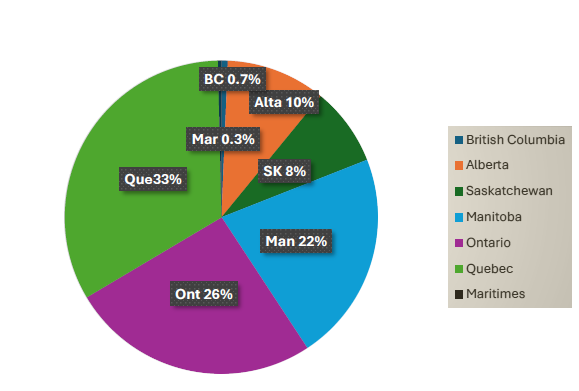
BC hog production, while important to BC agriculture, is a small market nationally and internationally. In 2024, Canada slaughtered about 21.26 million hogs, so BC is about 0.7% of the national production. Manitoba, Ontario and Quebec represented 84.5% of Canada’s total hog slaughter numbers in 2024. In 2025, there were 6,900 hog farms in Canada and the sector exported over 1.4 million metric tonnes of pork and pork products: for a total value of $5.4 billion. The top four markets were the US, Japan, China, and Mexico.